Compliance with Executive Order 13224

Executive Order 13224 – Blocking Property and Prohibiting Transactions with Persons Who Commit, Threaten to Commit, or Support Terrorism prohibits U.S. individuals or entities from making any contribution of funds to or for the benefit of entities or persons named on the OFAC-controlled (U.S. Treasury Department, Office of Foreign Assets Control) master list of Specially Designated Nationals & Blocked Persons. Revolution Composites is required to comply with EO 13224.

Revolution Composites is taking certain steps to ensure that no person or entity on the list of Specially Designated Nationals (SDN) or Blocked Individuals maintained by OFAC receives any contribution of funds, goods, or services to or for the benefit of those persons or entities listed in the Annex to this order or determined to be subject to this order.


Material and Process Development


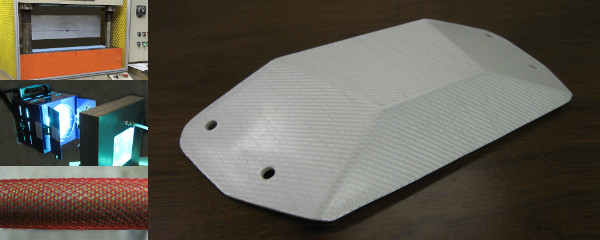
We are focused on developing production-level manufacturing processes for various carbon / TP composites such as PPS, Peek, and Acrylic.  Manufacturing methods include press molding preforms from co-mingled material and RTM infusion.


Other development efforts include manufacturing with UV cure resins and visually asthetic monofilament structures.


Braided Preforms and Fabrics


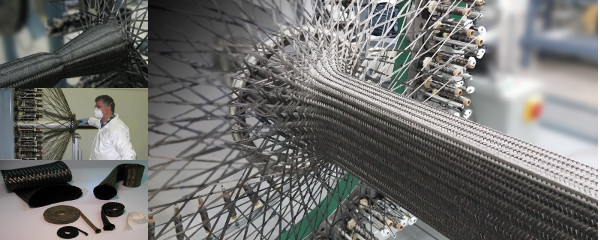
Revolution Composites has the capability to braid a wide range of fabrics and preforms. Our braiders range in size from 6 carrier up to 144 carrier machines.  This allows us to braid a wide range of yarn constructions with diameters from .1 to 36 inches. 

Contact us for custom braids or preforms.

Read more...

Vacuum Assisted Resin Transfer Molding is an infusion process that utilizes single sided tooling and consumable vacuum bagging materials to transfer the matrix resin from a holding vessel at ambient atmospheric pressure into the preform which is under vacuum pressure.

This process is beneficial for customers that have less stringent dimensional and surface asthetic requirements. One side is high quality tooling controlled while the other is bag surface (rough, fabric like texture).

BENEFITS:

  • Lower cost, single sided tooling.
  • Faster tooling aquisition time.
  • High dimensional tolerance on tooled surface.
  • Possible to use cauling to improve bag side dimensions.
  • Mature, proven process with high quality results.

CHALLENGES:

  • Requires highly skilled technicians.
  • Increased post molding opertions.
  • Higher recurring costs for consumables.
  • Longer process cycles.